Aroha Quartet
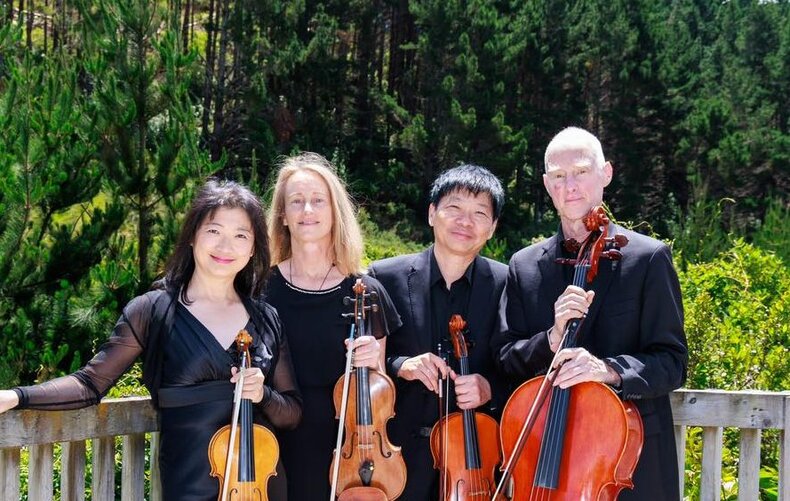
Playing from the heart (but not by heart!), the Aroha Quartet presents a programme of heart-warming music from the heart of the chamber music repertoire.
We begin with a sunny, sparkling piece by the father of the string quartet, Josef Haydn: his String Quartet in E-flat Op 64 No 6. The first half finishes with Barber’s only string quartet.
American composer Samuel Barber wrote in 1936 to a friend “I have just finished the slow movement of my quartet today (and) it’s a knockout”. Like a huge inbreath and outbreath, this amazing piece (often performed by string orchestra as the Barber Adagio) is flanked by two wonderful outer movements.
The second half begins with the lovely Toccatina by New Zealander Ross Carey. Our final piece, Beethoven’s glorious String Quartet No 10 in E-flat, covers the range of human moods, from tranquil calm, to restlessness, heartfelt outbursts and resolute determination. Its nickname, ‘Harp’, comes from the striking pizzicato section in the first movement.
The Quartet warmly welcomes its newest member, violist Eli Vincent. An Australian from Brisbane, Eli was living in Germany before joining the NZSO in 2023. He received his Bachelor of Music from the Queensland Conservatorium, Griffith University, and pursued further studies at the Australian National Academy of Music in Melbourne. Seduced by the European lifestyle during academy projects with the Mahler Chamber Orchestra and the Vienna Philharmonic Summer Academy, he began his Master’s studies at the Universität Mozarteum Salzburg in 2018. In 2020 Eli moved to Germany to play in the Staatsphilharmonie Nürnberg, where he remained until relocating to Wellington at the end of 2023. He now couldn’t be happier to call Wellington and the NZSO his home.
Aroha String Quartet Concert Review
Poster
Follow Aroha Quartet on Facebook
Aroha Quartet.co.nz
Heart Concert programme (Aroha Quartet)
Review of Aroha Quartet:
Concert Review
Tauranga Musica
Featuring the Aroha String Quartet
Sunday, 30 August at Baycourt X Space
Tauranga Musica is to be heartily congratulated for producing yet another fine afternoon of chamber music for an eager and enthusiastic crowd of music-lovers on Sunday, 30th August. The concert featured the Aroha String Quartet, an ensemble comprised of Haihong Liu (violin), Konstanze Artmann (violin), Eli Vincent (viola) and Robert Ibell (cello).
The afternoon opened appropriately with the Quartet in Eb, Op. 64, No. 6 by Franz Josef Haydn, who is often considered to be the ‘father’ of the string quartet. Composed in 1790, Op 64 (of which there are six in total), are frequently referred to as the “Tost” quartets, so named after the dedicatee, Johann Tost, a talented Hungarian violinist and who played in the Esterházy court orchestra who aided Haydn in finding a publisher for the set.
From the opening few bars of the first movement, it was immediately evident that Hadyn was in the hands of true professionals. Aroha’s sound was clean, clearly articulated, and beautifully balanced; capturing instantly and accurately the characteristic elegance, grace, and charm of the classical string quartet soundscape. The exquisitely textured and gentle Andante movement was treated delicately by the players; it’s serene and almost solemn tone providing an appropriate contrast to the outer movements. During the Minuet, with its dramatic sforzando accents and irregular phrasing, the quartet of players seemed to subvert courtly elegance for a more rustic edginess. Written in the Ländler style, the Trio was unapologetically Austrian in sound and in one magical movement, the melody was taken over admirably by Artmann, while Liu soared away above. Aroha burst with theatrical flair in the final Presto movement which was a tour-de-force from beginning to end. Their playing constantly teemed with energy and excitement throughout the movement’s entirety but especially in some rather rapid unison moments and some fantastically intense scrubbing at its climax. In the capable hands of the Aroha Quartet, this Quartet in Eb is most capably proved to be a masterclass in wit, structural surprise, and lyrical warmth.
The Aroha Quartet followed the Haydn with Samuel Barber’s String Quartet in B Minor, Op. 11 - Barber’s only string quartet incidentally, and arguably a masterwork of 20th-century chamber music. Aroha captured succinctly all the passion contained within the work’s fast and fiery minor key theme, all the time building, until coming to an utterly satisfying and surprising major key chord. For the second theme, Aroha’s delicate playing was softer, calmer, and almost hymn-like. The central movement of the Barber was later arranged by the composer as the famous Adagio for Strings. It’s structure is seemingly simple - utilising only a very basic rising and falling melodic phrase - but in the wrong hands, much can go wrong. Aroha constructed this movement so well, building intensity wave by wave to it’s massive wrenching and emotional finely-tuned climax. The sudden cut to immediate silence was palpable and profound, after which, Aroha resumed before gently fading away. The performance of this famous music was magnificently expressive and for the most part quite finely done, but for one or two questionable tones emanating from Ibell’s cello which did detract. Aroha regrouped quickly to bring back all the fiery energy and restless drive of the first movement, finishing the piece with a quick driving and utterly decisive conclusion.
The second half of the concert opened with New Zealand composer Ross Carey’s Toccatina - and what a welcome addition to the New Zealand concert stage this piece is! The opening movement featured numerous complex repeated rhythmic patters providing something of a heart beat to the movement - akin to a sort of perpetual motion throughout. Above this constant foundation in the lower voices, the two violins soared to stratospheric heights. The middle section was really very lovely and provided something of a respite from the driving rhythms and exacting counterpoint of the first section. But, that respite felt short-lived as the final movement took up the driving rhythmic mantle once more with a renewed sense of fervour and gusto. With so much going on harmonically and rhythmically, the construction of this piece can’t have been easy for the Aroha Quartet; nevertheless, they played powerfully, deliberately and decisively and in the end, the work felt both convincing and satisfying.
To close, the Aroha Quartet delivered Beethoven’s String Quartet No. 10 in Eb, Op. 74, a work written while Beethoven was hiding in a cellar during Napoleon’s 1809 bombardment and occupation of Vienna. Yet, despite all this war-like chaos outside, the resulting composition is serene, gentle and positive. The Aroha Quartet managed to convey all this, and so much more in their stirring account of the work. The first movement opened with a slow, languid, if not hesitant, introduction which soon broke into an ebullient and lyrical main theme, brimming with optimistic spirit. This movement was peppered by its characteristic, highly clever, and strikingly noticeable pizzicati arpeggios throughout from which the work derives its oft-used moniker “the Harp Quartet”. Liu’s final furious scrubbing at the movement’s conclusion was superb! The Adagio was tender and built, almost anthem-like, and featured elegant variations on a tranquil theme, foreshadowing the profound slow movements of Beethoven’s late period. Surely, this is to be counted among the most sublime moment’s of the afternoon - a poignant moment indeed when considering these pages of immense musical attractiveness were scribbled during a traumatic military attack and subsequent occupation. The driving Scherzo, as Aroha played it, was deliciously stormy and tempestuous. It would appear to almost channel the heroic and obsessive four-note rhythmic motif (short - short - short - long) of the more famous Symphony No. 5 in C Minor. The final movement featured a theme followed by six well-contrasted variations. Here, the Quartet balanced their own athletic energy with graceful, lyrical calm.
Though not large in size, the audience’s reception of this programme was enormous and unquestionably clear; and was made evident by their warm, enthusiastic and prolonged applause. The Aroha String Quartet are surely a taonga - convincing, competent, and comfortable in any multitude of styles or periods. What a fantastic concert and a well-curated programme! One can only hope to see more of the Aroha String Quartet on Tauranga concert stages in the future. A return visit cannot come too soon.
Chalium Poppy
Mount Maunganui, 2026
Previous concert
Next concert